

Human guided. AI accelerated.
Rethinking web design under impossible timelines.
A NEW WAY TO PLAY
Foundry Labs needed to move fast. With two Microsoft web experiences to design and launch in just five weeks, a traditional process wasn’t going to get us there.
Rather than treating AI as a shortcut, I treated it as a creative collaborator. Using Claude, I explored site structures, generated working concepts, challenged assumptions, and accelerated the journey from blank page to tangible design. The real value came from exploring more possibilities in less time and quickly turning abstract conversations into something stakeholders could react to.
What surprised me most was how much the role shifted. Instead of starting with blank canvases, I found myself guiding, editing, synthesizing, and making decisions in real time. The result was a new workflow that blended the speed of AI with the judgment, intuition, and craft of an experienced designer.
Duration
Mar 2026 – Apr 2026
Project
AI Assisted Design
Content Strategy
Information Architecture
Tools
Claude
Figma
Roles
Creative Direction
UX + Visual Design
Prompt Engineering
WORKFLOW
FROM PROMPT TO PRODUCT
AI was integrated directly into the design process, compressing activities that traditionally happen in sequence. Concepts, interface explorations, and implementation artifacts could be generated, evaluated, and refined in rapid succession.
Rather than producing disposable experiments, many outputs became the foundation for real components and interactions that ultimately shipped. Design shifted from manually creating every artifact to directing systems, evaluating possibilities, and transforming promising outputs into cohesive experiences.
The speed of exploration increased dramatically, but human judgment remained the mechanism that gave the work clarity and coherence.
EXPERIENCE DESIGN
DESIGNING FOR DISCOVERY
Foundry Labs wasn’t designed around a single search box or a predefined journey. The challenge was helping people discover emerging innovations they may not have known existed. Some visitors arrive with a clear objective, while others are simply exploring.
To support both behaviors, the experience was designed around multiple paths to discovery. Innovations could be surfaced through domains, capabilities, technologies, and conversational interactions like Labs Ask Me. Rather than forcing users down a single path, the platform encourages exploration and creates opportunities for unexpected connections to emerge.
OUTCOME
MAKING SENSE OF INNOVATION
Emerging technologies rarely fit neatly into a single category. An experiment might simultaneously belong to multiple domains, capabilities, and areas of research, creating a challenge for both organization and discovery.
Foundry Labs required a flexible taxonomy that could describe innovations through multiple dimensions without overwhelming the experience. By treating metadata as a system rather than a hierarchy, innovations could be organized, connected, and discovered through different lenses while remaining adaptable as the ecosystem evolved.

TURNING COMPLEXITY
INTO CURIOSITY
DISCOVERY AT SCALE
BRINGING FOUNDRY LABS TO LIFE
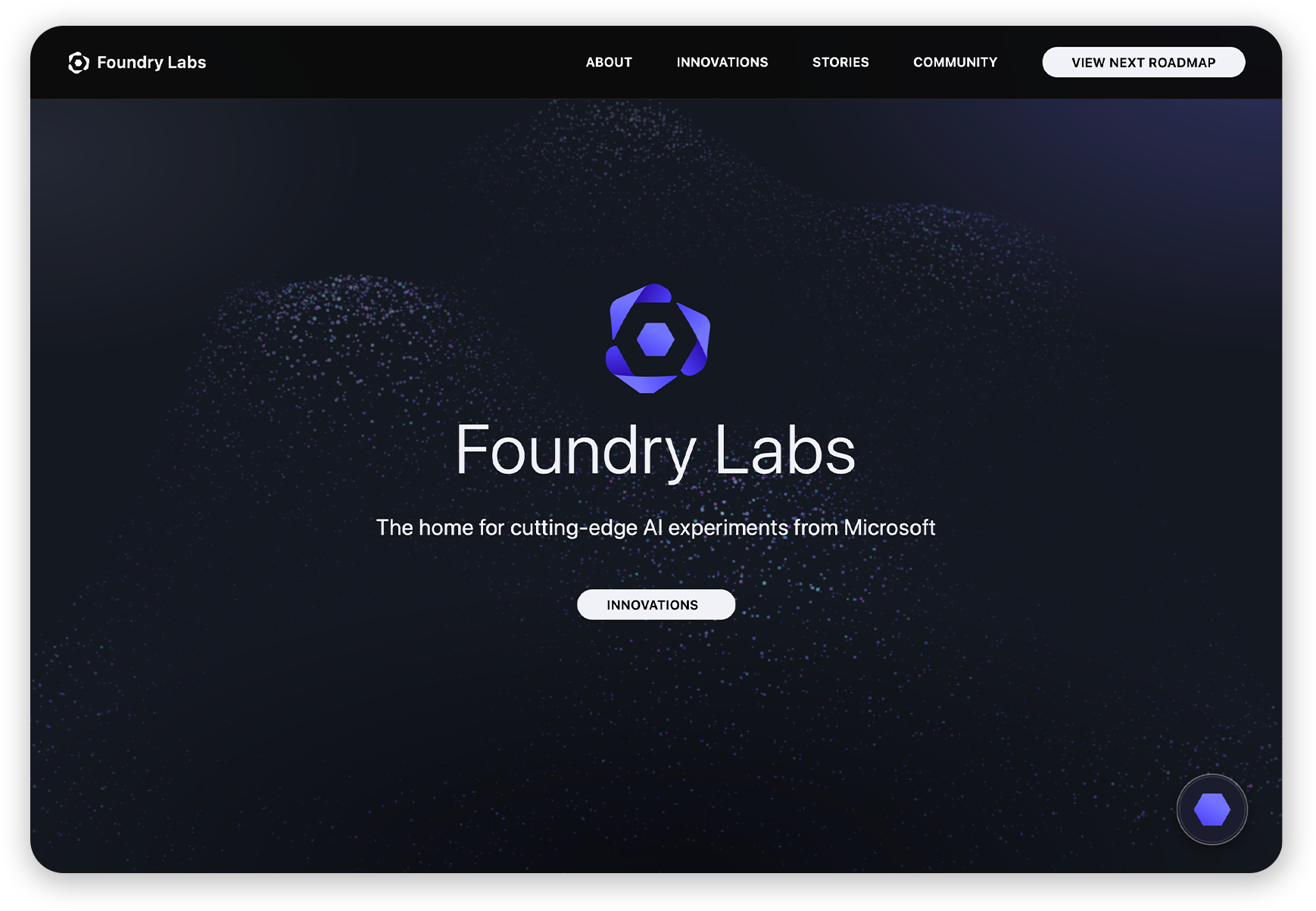
Foundry Labs was designed as a destination for exploring emerging AI research. The homepage, community experiences, and editorial storytelling worked together to transform individual experiments into a living ecosystem where people could discover, learn about, and engage with new technologies.
A LIVING ECOSYSTEM
Foundry Labs extended beyond experiment pages. Community spaces and editorial stories created opportunities for people to follow emerging research, learn from real-world applications, and engage with the ideas shaping the future of AI. The platform was designed not only to showcase experiments, but to foster exploration, conversation, and shared discovery.
DESIGNED TO EVOLVE
Beneath the experience was a flexible publishing system built to scale. The innovations directory and four modular page templates created a repeatable framework for organizing, publishing, and continuously expanding the platform as new experiments emerged.
WE ARE HUMAN
THE PROCESS
IS THE THING
Foundry Labs proved that AI can dramatically accelerate execution. Concepts emerged quickly, decisions happened faster, and a production website came together in a fraction of the time a traditional process would have required.
In moving from prompt to production so quickly, we eliminated the time and space for exploration, ideation, experimentation, and creative discovery. We lost opportunities to fail, challenge assumptions, test ideas, and discover what actually worked.
Good design is not found at the end of the process. It is discovered through it.